
Harnessing the power of quantum compute
EXOq, the Exeter Oxford Quantum Innovation District, is a proposal by Exeter College, Oxford for a quantum compute site and innovation district on land at Frieze Farm, between Oxford and Kidlington, within walking distance of Oxford Parkway railway station.
Located within a parkland setting, EXOq will be home to sovereign high-performance compute, quantum-ready infrastructure and artificial intelligence which are critical in tackling the defining challenges of our time; from designing new drugs and therapies to modelling climate systems, discovering advanced materials and accelerating the path to clean energy.
With an innovation hub and further education college on-site, EXOq will enable Oxford’s world-renowned research to progress from theory to impact.
This page explains the proposal and responds to questions raised.
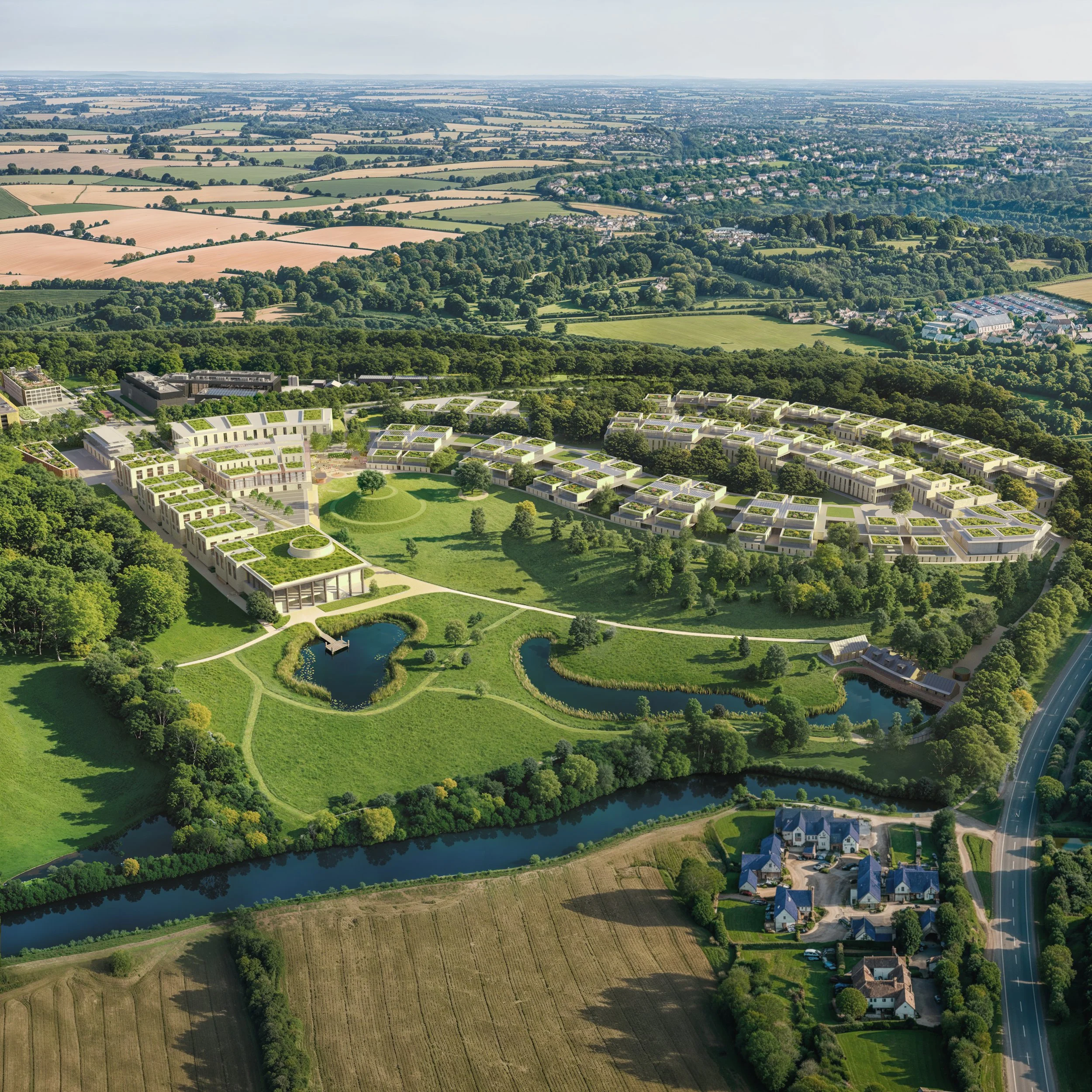
Illustrative view shown at the November 2025 consultation.
What is EXOq?
EXOq aims to be the pre-eminent site for the development of quantum computing in the UK and Europe, leveraging Oxford's world-renowned strengths in research, innovation and quantum. It would provide a purpose-built home for UK quantum computers.
To remain a leading force in scientific and technological development, the UK will need its own quantum hardware. EXOq aims to provide a home for businesses that need shared services, including significant compute power on site.
EXOq would support research and development in many areas requiring significant compute power and data storage capacity, such as climate change, advanced materials, particle physics, space and satellite technology, NHS data for drug development, and the development of computer science and AI.
The proposals combine research and development space, higher and further education, sovereign quantum and high-performance compute (HPC) infrastructure, an energy centre linked to a district heat network, a hotel, a small number of homes and a new public park.
Built for quantum research
A purpose-built home for UK quantum computers, with space for research, development and education.
Sovereign, and not for general use
High-performance compute for UK scientists and developers, with systems and data under UK law.
Energy used twice
Heat from liquid cooling would feed a district heating network, in partnership with 1Energy.
A 14 hectare public park
Landscaped parkland with a café and community room, connecting to Stratfield Brake.
A bridge to Oxford Parkway
A new foot and cycle bridge across the A34 and the railway to Oxford Road.
The compute at the heart of EXOq
High-performance compute
High-performance compute brings processing power, memory, data storage and networking together at a scale far beyond everyday computers. At EXOq it would be sovereign and would serve the research fields described above.
Harnessing the power of quantum compute
Quantum computers are the next step. A conventional computer stores information in bits, each of which is either a 0 or a 1. A quantum computer uses quantum bits, known as qubits, which can represent a combination of both at once, and this lets it approach certain problems in a fundamentally different way.
Quantum computers are expected to help researchers working on medical treatments, climate change, advanced materials, and space and satellite technology. They are expected to work alongside high-performance compute and not to replace it, which is why EXOq would house the two together.
Where quantum computers are expected to help:
Why Here?
The infrastructure would be sovereign, which means the systems and the data held on them would be subject to UK law. This protects intellectual property and avoids personal and other data leaving the country.
For reasons that include sovereignty and the speed at which systems respond, the compute needs to be on site and close to the researchers who use it. Exeter College is one of the colleges of the University of Oxford, was founded in 1314 and is a charity whose income supports teaching and research.

Where the application stands
Public exhibition
We held a public exhibition and invited feedback online on our early proposals.
See the 2025 materialApplication submitted
An outline planning application was submitted to Cherwell District Council, which is the local planning authority. The reference is 26/00720/OUT.
Awaiting decision
The application has not been decided. Cherwell District Council is accepting comments on the planning application until 3 December 2026.
Detailed designs
The detailed design of the buildings would be considered later through further applications, known as reserved matters.
An outline planning application asks the Council to decide whether development of this kind is acceptable, in principle, on this site. The detailed design of the buildings is not fixed at this stage and would be considered later through further applications, known as reserved matters. The application documents can be read in full on Cherwell District Council's planning register by searching for the reference: 26/00720/OUT.
Questions we are being asked
These are the questions residents have raised with us and with the Council.
Is EXOq a data centre?
In part. EXOq is proposed to be the pre-eminent site for research and development supported by quantum computing capability in the UK and Europe. This specificity means the data centre component would be modest in scale (MW not GW). At its core, the plans include a dedicated sovereign High-Performance Compute (HPC) facility. The wider district is proposed to offer research and development floorspace, a further education college and an Innovation Hub. Almost half of the 30-hectare site, 14 hectares, is proposed to be community parkland.
How much water will EXOq use?
EXOq is proposed to use a closed loop Direct Liquid Cooling system, which recirculates the same water instead of drawing a continuous supply. The amount of water EXOq would use would be confirmed through the detailed design work that follows the determination of the outline planning application. As part of that process, Thames Water would carry out detailed modelling and complete any network upgrades needed.
How will EXOq be powered?
A new high-voltage connection to the grid would supply EXOq, and this could be supplemented by on-site renewable energy. This may include roof-mounted solar PV and ground-mounted solar PV arrays as well as battery energy storage systems (BESS). The proposals include an Energy Centre beside the HPC facility, to manage both energy supply and excess heat.
Will EXOq create noise for nearby residents?
The noise generated by the cooling and district heat network equipment has been predicted to be lower than the background noise levels, such as highways, at all the sites identified as sensitive to noise. Direct Liquid Cooling is also quieter than conventional air cooling. Detailed modelling work in respect of noise would also be included in any future planning application for the specific elements of EXOq. Further details are available in Chapter 9 of the Environmental Statement submitted with the outline planning application.
What happens to the heat
The energy would be used twice, once to power the compute and again to provide heat.
Compute is cooled with liquid
Direct liquid cooling would be the predominant method. It is much more efficient and quieter than air cooling.
Hot water is captured
The hot water from cooling would pass to 1Energy’s energy centre, which would be located on the EXOq site.
Heat reaches buildings and homes
It would serve the EXOq site, as well as buildings and new-build homes in the City of Oxford and the local area. Connected buildings would not need individual gas boilers.
We are partnering with 1Energy, which is developing a district heating network for Oxford and the surrounding area. The Oxford Energy Network is backed by £21 million from the Government's Green Heat Network Fund and £100 million of private investment.
What EXOq would bring to the local area

A new public park
A 14 hectare landscaped park with a café, a community room and public facilities, with limited car parking and a connection to Stratfield Brake.
Additional flood storage
The low-lying wetland next to the canal on the west side of the site would provide additional flood storage capacity. Flooding is often a significant problem in Kidlington.
A further education college
Courses for 16 to 18 year olds in computer hardware, data management, and data handling and regulation, offering technical and vocational routes in addition to university.
A foot and cycle bridge
To Oxford Road and Oxford Parkway station.
District heating
For buildings and new-build homes in the City of Oxford and the local area.
Jobs
EXOq is expected to provide over 7,000 jobs once it is fully built out.
ProQure and the UK's quantum computing programme
In March 2026 the Government announced up to £2 billion of investment in quantum technologies, with the aim of making the UK the first country to build and deploy quantum computers at scale by the early 2030s. At the centre of that package is ProQure, a programme to procure large-scale quantum computers that will form part of the UK's national computing infrastructure.
Building these machines is only part of the task, because they also need somewhere to operate. That means secure, purpose-built facilities with resilient power, cooling and connectivity, close to the researchers and companies who will use them. EXOq is designed to help meet that need, as a purpose-built home for UK quantum computers.
Figures from the UK Government announcement of March 2026.
What has changed since the 2025 consultation?
The material shown at the November 2025 exhibition is still available. We have kept it as a record of what we consulted on and have not updated it, so some details differ from the submitted application.